Character Journals 1 and 2
My first two character journals are combined into one. I divide my circumstances into historic and immediate. I pose questions for both as suggested in character journal one and answer any unknowns as suggested in character journal two. (I added on and revised my character journal 1 with more discoveries and answers in character journal 2.)
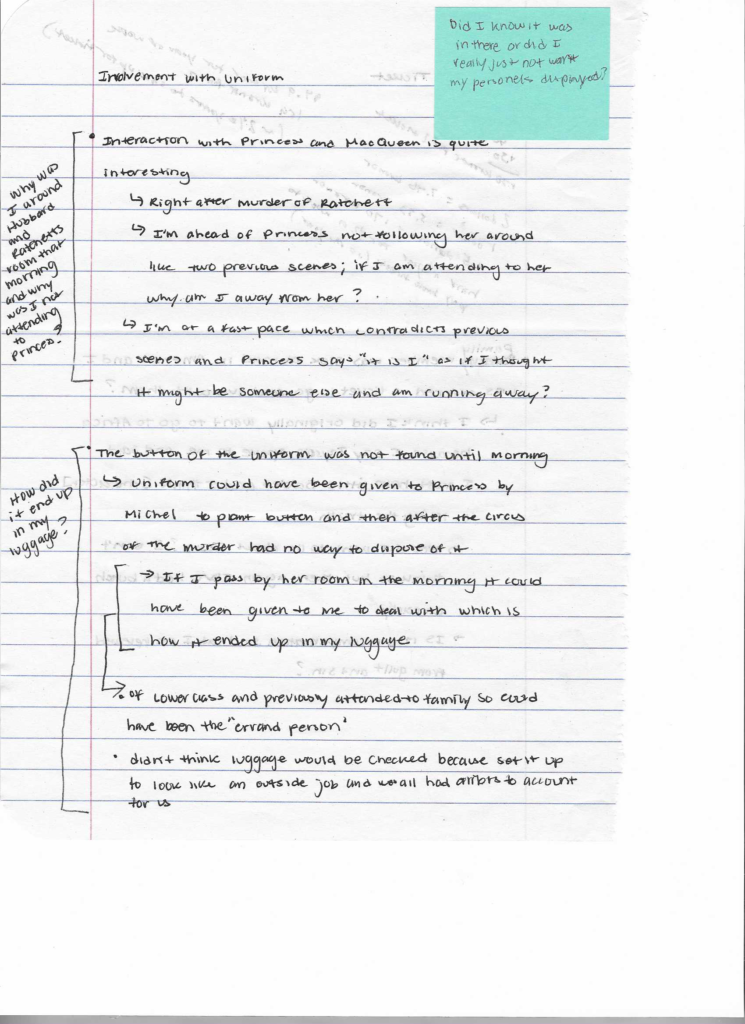
Specific points in my research that influenced the story I built for my character are incorporated into these journals.
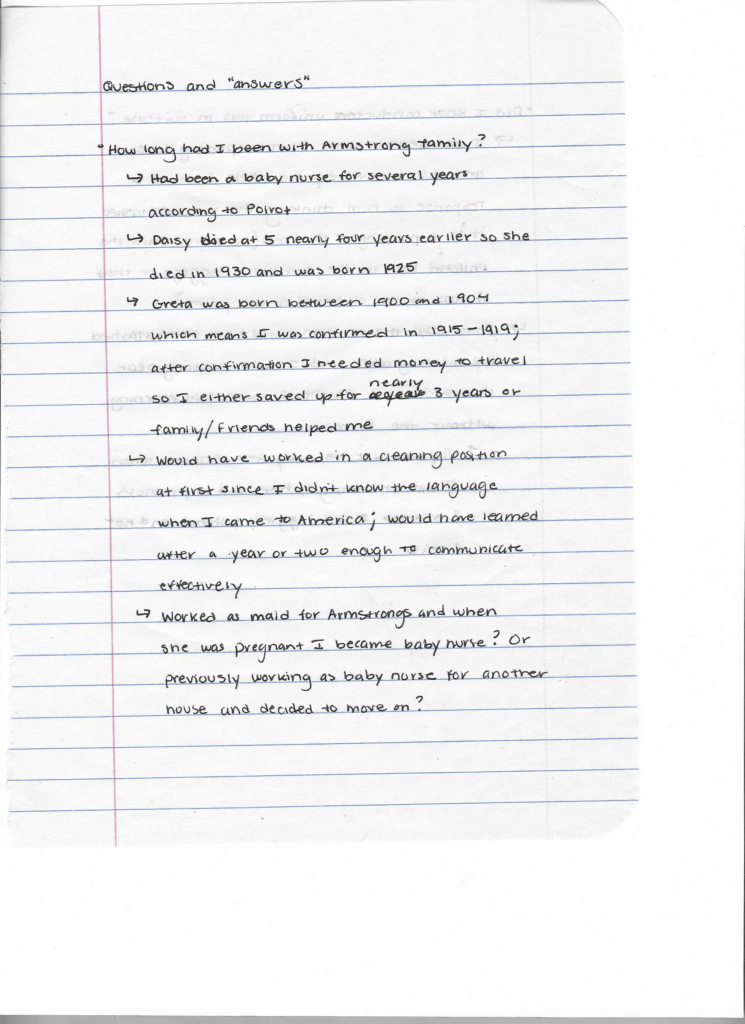
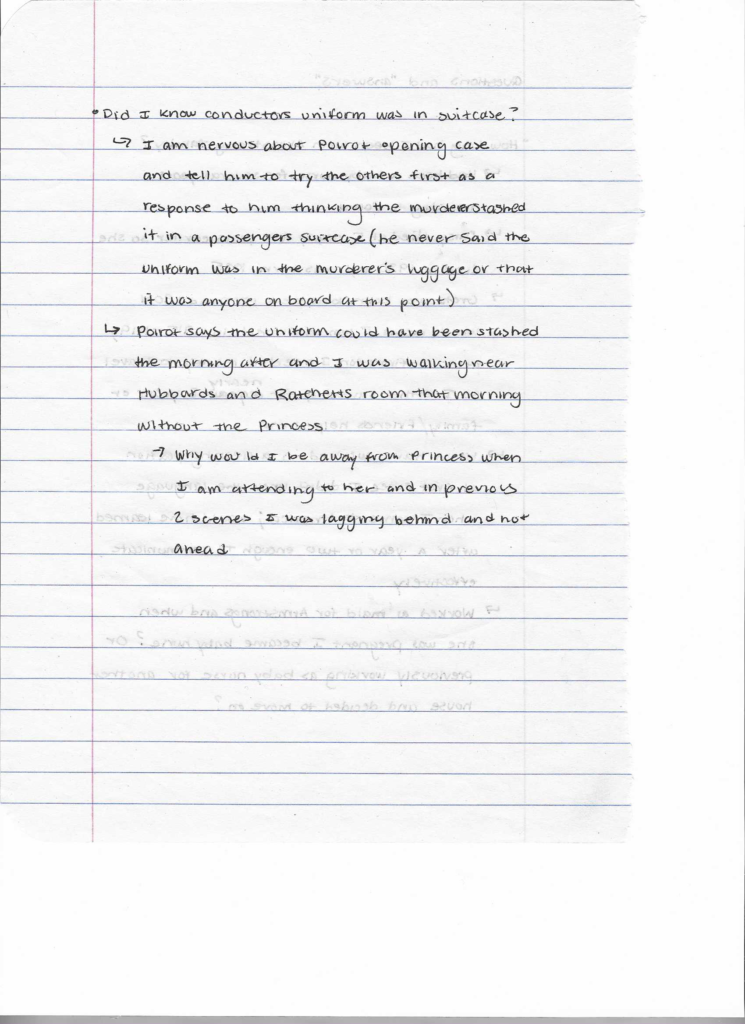
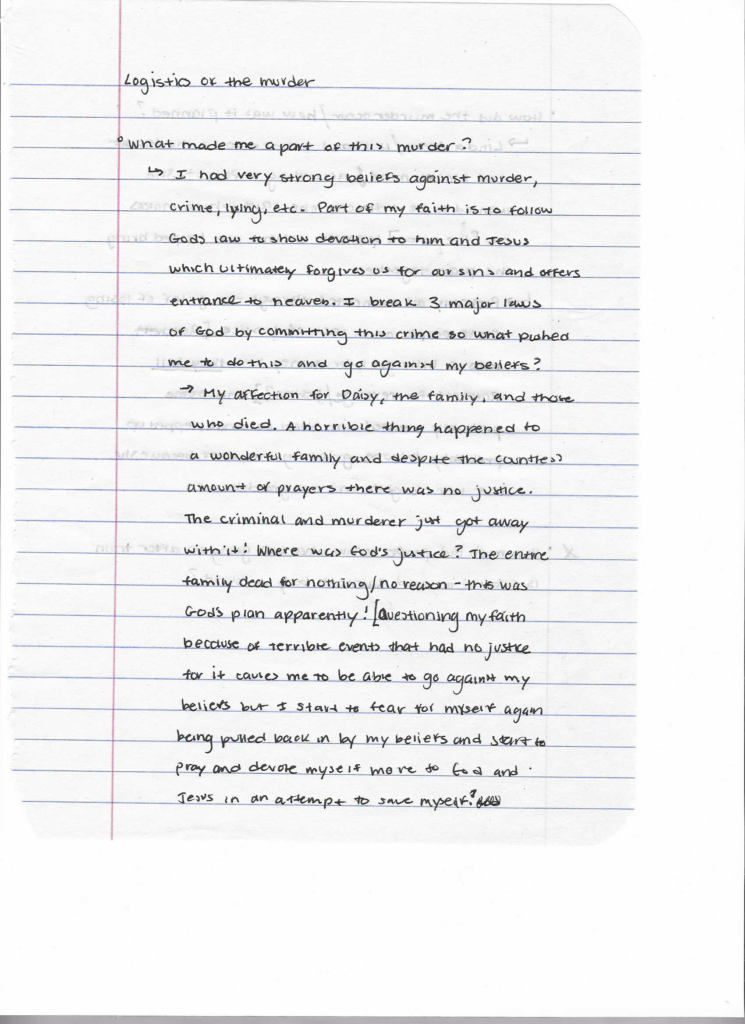
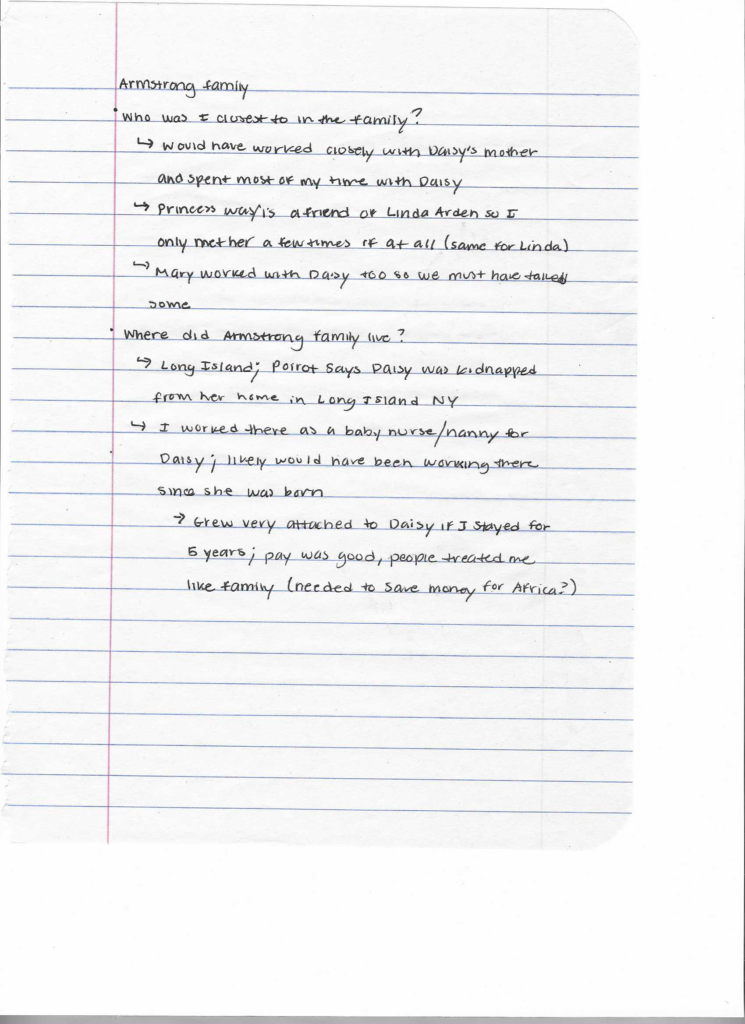
There is more research and questions from my exploration of circumstances that were written down physically and are attached separately.
Historic circumstances
- Greta is 30-34 years old ( I suspect 30 years old because she would have been born in 1904 putting her at 7 years old in 1911 when children in Sweden started attending school and finishing at 14, 7 years later if my schooling was not balanced with work. At 15 years old it was typical of Swedish children to be confirmed into Christian Lutheran faith which signified they were adults and expected to go and work. In 1919 Greta would have been confirmed if born in 1904.
I conclude that Greta is 33 years old meaning she was born in 1901. I say 33 years old because she had to have some experience in childcare in America before working for the Armstrongs which were a middle-upper class family (they had a maid, nanny, cook, governess, and chauffeur in the book). According to “I Go to America” Swedish immigrant women needed experience before working for upper-class households. Greta started working for the Armstrongs around 1925 because Daisy was 5 when she was murdered and Poirot/Bouc say that the case happened four years ago from the time of the play, which is 1930. Greta was born in Sweden and in order to get a ticket to America I would have had to save up money from working for at least 2 ½-3 years (In I Go to America ticket costs in kronor were detailed and as well as average pay for those in the working class/domestic work and I [the actor] calculated approximately how long it would take for someone to save up their wages for a ticket). In Sweden children in the working class are usually working for their family and community from the time they are 7 which is when children start school too. Education for children in the working class was about 7 years if that was not exchanged for working at home to support the family. At 14 they finish school and by the time they are 15 many are confirmed into the Lutheran church. (In I Go to America, the separation of church and state was very recent for Sweden and their national religion was Lutheran Christianity. Although there was a separation during my time growing up there it was still common for many children to be confirmed as it signified the transition to adulthood. Christianity and the bible were still part of the school curriculum at times. After children were confirmed they were expected to start working. Given how religious Greta is in the play it is safe to assume that she learned a lot about the faith from school, community, and from the months of lessons required to be confirmed. That means Greta was still in Sweden when she was 15 and started working shortly after. The main two jobs that many of the working class went into was “barnpiga” or nursemaid or field worker. Given Greta’s desire to work with children she likely tried to find a job as a barnpiga or a maid. (I place Greta in a working-class background because 70% of Sweden was agriculture since it was its biggest industry with only 30% urbanized areas by the early 1900s; many opportunities for a working-class job. Because of the large number of working-class families with poor pay, there was a strong sense of community among the people, often trading supplies and helping out others like watching children. It was not uncommon for older children to take care of other children while the parents worked around the house, in the fields, or in factories. Family sizes were large too around the 20th century, averaging about six children, meaning Greta could have come from a large family and been responsible for caring for siblings as well as other children in the community, giving her some experience to acquire a job as a barnpiga. Having this additional experience prior to America could have also helped her acquire a position in America. If she started working around 15/16 and assuming she paid for the ticket to America herself, she wouldn’t have saved up enough until she was 18/19. Her move to America then was around 1919/1920, leaving 5 years of time in America before the Armstrongs. In “I Go to America”, women were immigrating without any knowledge of English and still acquiring jobs due to translation books and the ease of showing cleaning expectations rather than dictating. Many women learned English in 1 to 2 years from working in households and expressed it was easier to learn English when children were around. Maid was the easiest job for a Swedish immigrant to acquire and likely is what Greta started in when coming to America. I would say it took Greta 2 years of working in America in order to acquire enough fluency to communicate meaning there are around 2 years where Greta could start working as a nanny/nursemaid, gaining more experience to work with higher class families and earning more money. Greta states that she is a missionary in both the book and play which I [the actor] believe to be true. In America there were many Swedish churches that were established because of the booming of immigrants during that time. Given that Greta’s accent is still thick based on the way the playwright chose to write her lines, it seems like she still speaks Swedish or is around other Swedish people enough to slow down the process of “assimilation” by 1934 she had been in America for around 14 years which seems like a good amount of time to start to affect her accent. Greta was part of a missionary group within a Swedish church in America to remain connected to her home and devote herself to Jesus through spreading his faith and word, as well as helping others. There was a missionary movement during this time for Nordic citizens to emigrate to America for the church. Greta was a part of a church and missionary group in Sweden before she was sent to America in order to work there. She was working there for a year as a missionary before the church could not find enough funds for their missionary movements anymore so she started her journey to nanny because she wanted to help children and needed more money that what the church was fundraising. She wanted to stay in America because of the better opportunities. The death of Daisy propelled her to work as a missionary again and escaping to Africa to do work there.
- Daisy died 4 years prior to the events of the train and was about 5 years old when she was murdered meaning Daisy was born in 1925. It seems like Greta has been working for the family for some time considering the close connection between Mrs. Hubbard and her in the book and her involvement of the murder of Cassetti. She cared deeply about this child enough to throw away her beliefs. Nursemaids and nannies were typically hired for the birth of the baby and to help take care of the child. Daisy was reaching an age where a governess takes over the care but Mrs. Armstrong was pregnant again which is probably why Greta was still hired to care for Daisy until the time of the new baby.
- Greta had to acquire a ticket to go to America and there had to be a reason for her departure from Sweden. It would take Greta three years to save up her money in Sweden to go to America unless she had help from friends or family or the chruch. Since Sweden was 70% agriculture based in early 20th century many families were in the poor working class and is unlikely that her family could afford to send her all by themselves or that the church could fully support her. She would have had to work for some time in Sweden to acquire the money to go. It is possible she had a family or friend in America already since Swedish emigration to America started around 1880’s and 1915-1919 was nearing the end of the emigration (1930’s it slowed completely).
- For Greta to be working for the Armstrongs in 1925, considering they were a wealthy family, she would have need to speak English and previous experience taking care of children. It is unlikely that when she came to America she immediately got a job as a nanny because she could not speak English (It was more than common for Swedish women to immigrate to America without knowing English. Tasks for maids (which was the market for Swedish immigrants) and expectations for cleaning could be shown and there were translation books and sections in newspapers to help them learn English. There was a popular cooking book as well with recipes in both English and Swedish. Many Swedish women found it easier to learn English when children were in the house they were working in. Greta likely would have worked as a maid until she learned enough English to start working with children.
- Believing that Greta has worked for 5 years in America before the Armstrongs begs the question if she had enough experience working with children to acquire the job. It would have taken her 1 to 2 years to learn the language enough to communicate effectively (at any point she could have found a number of jobs since changing positions was allowed at any point [no year long contracts like in Sweden] and occurred often because Swedish women were in demand for such positions due to stereotypes) Leaving around 2-3 years or where she could have been working with a family in caring for their child. Stereotypes or not a family would still want to hire someone who has worked with children or expresses extreme interest. Swedish rural families were very community-based as they often could not afford what they needed. Children were encouraged to work starting around the time they started school or even before. They would contribute around the house and the average family size was 6 in late 19th century and by mid 20th century the average was 2 so it is likely that Greta had siblings and helped to take care of them, or helped around the community and watched over the children of others. “Barnpiga” or nursemaid was one of the two most common jobs for people of working class families to go into. The other was field work and since Greta expresses she “does” or wants to work with children in Africa and already has worked with children in America it seems she is more likely to work as barnpiga. This means she had experience prior to coming to America and likely helped her get hired for the Armstrongs.
- In the book Greta said she was going to Lausanne to visit her sister. She has at least one sister who lives near Sweden (In Switzerland)
- Greta went home to visit her family after the murder, trial, and plan to murder Cassetti. In the book it says she was going home for the holidays but first going to Lausanne to visit her sister. This means she still has family in Sweden. When she is about to commit murder let alone a sin that she could be locked up for and is doing something she herself nor her family could imagine her doing, she would want to go home to see them; especially after the events of the murder and trial.
Questions still about historic circumstances:
- Where am I going with the Princess? What are my travel plans to Africa? Train to England and take ship to Africa? Train to England would put Istanbul out of the way so why was Greta in Istanbul (besides the murder obviously)? Visiting sister in Istanbul before heading to England?
In the book Greta says she was a part of a missionary school near Stamboul (Istanbul). That could be what she says she is doing in Istanbul.
- When was Greta on a train? because it wasn’t to Africa (she hadn’t been until after the murder on the train)
- Why did Greta go to America?
I have wanted to help children since I was a child and at 15 I began working to save up money for traveling somewhere to help children elsewhere. I worked with a missionary group/church in Sweden where we helped children and raise money. Greta wanted to expand the impact and Jesus so she decides to move to America. Perhaps because World War 1 happened and they were involved and affected. She learns English while working as a missionary in a Swedish church in America and as a maid after the church could not raise enough donations so it closed down. She wants to start working with children once she learns more English so she gets a job as a nursemaid/nanny. She starts working for the Armstrongs so she could make more money to go to Africa as a missionary. I plan to leave but Mrs. Armstrong is pregnant again and she asks for me to stay. I agree because I’ve grown attached to the family. When Daisy is murdered and Cassetti gets away there is no justice despite having prayed for the safety of Daisy before she murdered and prayed that God would enact justice. Then seeing the entire family slip away one by one despite the countless prayers. Seeing the grief of the rest of the family and the people who worked at the house. Going in to grab your things but the house is empty, no giggling little girl, no mother and father in the kitchen dancing, baby supplies scattered everywhere, toys collecting dust. I begin to question my faith if an entire family can be wiped away and the man who did it to get away with it. My prayers weren’t answered and there seems to be no reason behind why this has happened, no greater plan. The distress of the events is mixed with the distress of questioning your faith, a faith which is reliant upon the devotion to Jesus and the Ten Commandments. The guilt and despair I experience makes me want to cling onto my faith even more and prove my devotion to Jesus and his ways and going to help children in Africa would do that. I have enough money from working with the Armstrongs and I am certainly not staying in America after I watched an entire family decay away in front of my eyes. I plan to leave but then the plan to murder Cassetti is brought to my attention. I was clearly upset enough about the death of Daisy and what happened to her family to commit the biggest sin of all, murder.
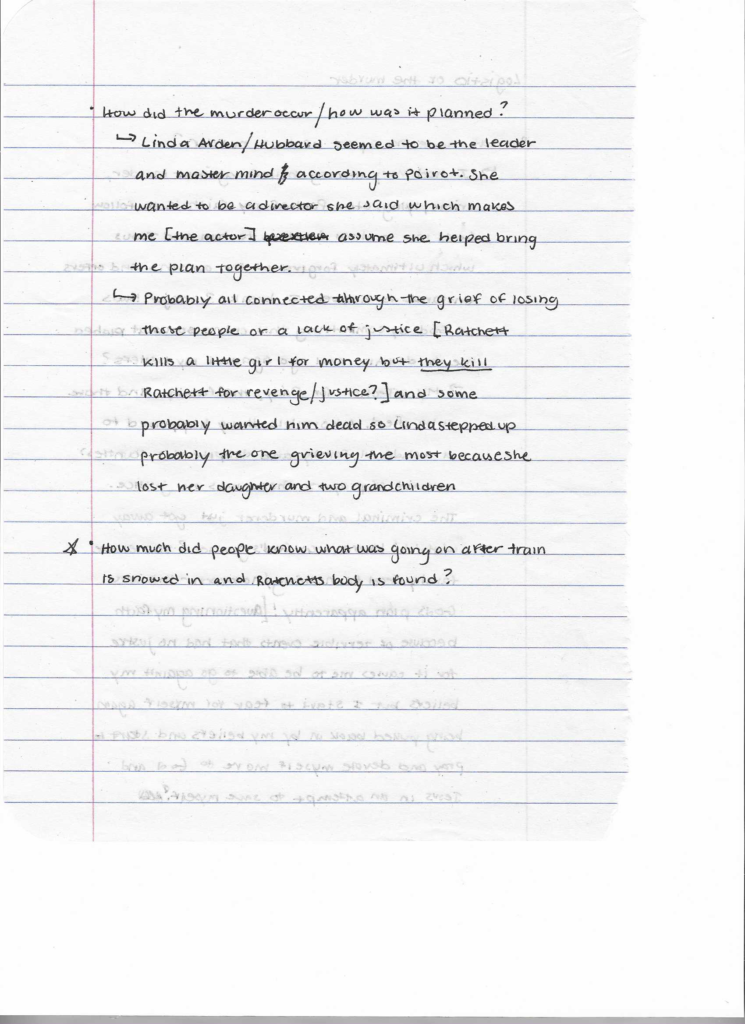
- How was the murder of Cassetti planned?
Greta was most likely one of the last to be told the plan and asked if she wanted to be a part of it. I have already been questioning my faith and have felt heartbreak after heartbreak for this family. In the Bible those who break Gods law always get what’s coming to them, but Bruno Cassetti didn’t, he go away with it. This plan being brought to Greta could have convinced her that this was a sign from God and this was the justice for Daisy that was supposed to happen. She still is afraid of the idea of taking someone’s life and she is questioning and praying for a sign or an answer. She is rather calm, compared to later scenes, up until after Poirot is on board the train. Greta takes Poirot’s presence as a sign that this is the wrong thing and I start to question and doubt all over again. I imagine seeing Cassetti and talking to Princess holds her over until the train stops because of the storm. Mary describes that I was anxious and I talk a lot when I am anxious so I took the train stopping as another bad sign but it was already too late and begins to freak out again.
Greta knew the basic facts of the plan, he was to be on a train, they all have alibis from 12 to 2, and they will make it look like someone boarded one station in a uniform and got off on another after killing Ratchett/Cassetti. No one was ever supposed to know he was Bruno Cassetti or there was never any talk of handkerchiefs and pipe cleaners with Greta. Greta knew hardly anything about the plan after the snow stopping and Poirot being on board messed up their original plan
- Was Greta at the trial for Daisy?
I would say she would be part of the trial if she had evidence that was substantial to the case. Police officers would have came to the house and been there for 3 days before Daisys body was found. Officers questioning me and getting aggressive
In the book Mrs. Hubbard/Linda Arden says that the day he got away with the murder the twelve vowed to carry out the death he deserved.
- Did Greta always want to go to Africa or was this a result of Daisy’s murder?
I don’t think she would have lied about something to do with Jesus. She has already committed countless sins true but she has already started to breakdown from the beginning of the play and lying is different when it is about Jesus I would think.
- How long did it take for them to figure out it was Cassetti and how long did it take to prosecute him and hold a trial? How fresh is Cassetti getting away with it?
In the book Cassetti had been arrested 6 months later. Poirot tells that the Mrs. Armstrongs shock to Daisy murdered caused her to give birth prematurely and both her and the baby died. Mr. Armstrong killed himself after said Poirot. He then mentions the suicide of the French maid before he mentions Cassetti going to trial which makes me think it happened before Cassetti was found.
Immediate Circumstances
Scene 1
Greta has been working with the family for nearly 5 years now. Mrs. Armstrong is pregnant with her second child.
It is Daisy’s bedtime and Greta is the one to put Daisy to bed and tuck her in which makes me think she had a very strong bond with Daisy and could potentially had held her in her heart as her own.
Greta is the last one to see Daisy after tucking her in. She probably felt guilty for a while thinking there was something she could have done to protect her. She could not help or save this little girl even after her death when her killer got away and there was no justice.
Daisy was missing for days and said to be held hostage until the kidnappers received money but even after giving them money Daisy was found dead, having been so for days.
How did Cassetti get away it? What were the details of the case and murder?
Sometime after this the murder of Bruno Cassetti was planned.
Scene 2
Where were Greta and the Princess during this scene? Were they at the hotel or did they not arrive until later?
It is likely they are staying at the hotel since a large majority of the murder party was and they had been traveling and need a place to stay. Princess had many suitcases so perhaps they were packing and preparing still while the others waited in the lobby/restaurant of the hotel. They took a car that Princess paid for to get to the station.
Scene 3
The train is departing in twenty minutes from platform 10. It is nighttime but unclear what time exactly. Poirot and Bouc talked about eating dinner on the train so around dinner time? 7 o’clock? (Train departed at 5 o’clock; Poirot says so in the last scene)
Greta enters carrying four pieces of luggage for the princess and herself. They are extremely heavy but Greta insists on carrying them herself.
Michel enters to show them to their compartments and get them settled in.
Princess has taken this train before? Or Michel knows from previous interaction with her that she is usually accompanied by Miss Schmidt but Greta jumps in quickly to say she is very sick.
Princess is in compartment eleven and Greta is sharing with Mary Debenham in compartment four.
We get on the train after Michel tells us our compartment numbers.
What is happening while the others talk? In the next scene we move through the dining space to our compartments so they didn’t settle in immediately.
Is there a discussion about the murder (subtle or not subtle) or is that too risky considering they are still in a public space?
Did anyone know who Poirot was before he said his name? Did Mary, Arbuthnot, or Mrs. Hubbard (Linda Arden) pick up on who he was in the previous scene and tell the others?
Greta does not know who Poirot is until after we have settled in our compartment. Princess tells me there is a detective on board who was told by Mrs. Hubbard/Arden. I begin to panic because I start to question whether this is the right thing to do or not. I took it as a sign from God to be a part of the plan when I was approached by Linda Arden and the others with this plan. The fact that Poirot is on the train makes me think this is a sign not to do it. I’m already having moral qualms over it but because I saw the plan as God’s justice since Cassetti got away I tell myself it is okay and by the time we are on the train the plan is already in place and is too late to back out now.
Scene 4
Princess and Greta have just boarded the train and are walking through the first-class dining car to reach their compartments.
Princess wants to get to their compartments and get settled before the trains starts moving and is rushing Greta along.
Greta does not like being on the train, she has not liked them since she was a little girl. She does not like how small they are and all the people/strangers on the train.
Greta feels better knowing she is sitting next to the Princess
Greta describes that she was on a train to Africa and there was so much noise and she was trying to read and she looks up to see a very old goat sitting there and he became her companion. She says that her and Princess will not be so different to that. (When was Greta on a train?)
Greta was on a train when traveling to America. She had to get on a train when she arrived in America to travel to the Armstrong’s household. She decides to say she has not been to America she says she has worked with babies and when Poirot knows about the Armstrong case, he might tie her to it. Also she talks about Africa so much it seems like she is focused on the future and trying to block out her past because of the murder and deaths.
They exit to go to their compartments to settle in. Greta likely goes to the Princess’ compartment to settle her in first before she goes to her own compartment.
The train starts and takes off at the end of the scene.
Scene 5
It is later that evening/night and Hubbard, Ratchett, and Poirot are all in their rooms. Poirot and Ratchett are getting ready for bed which means its after the dinner Poirot and Bouc were supposed to have.
Ratchett says it is the middle of the night and then says it is twelve o’clock.
What were Greta and Princess doing before and during this time?
- My job for Princess was to accompany her through the journey. Princess is older and needs the help. Princess would have Greta fetch her stuff carry her luggage, likely help her get settled for bed (getting her a drink, medicine, anything else she needed). I was likely doing some o this during the 7 hours that passed from 5 o’clock when the train departed in the previous scene until 12 o’clock of this scene where Ratchett complains about Hubbard. We had dinner at some point between then in the dining car. Princess seems to be annoyed with Greta at times and likely wouldn’t want to be in her presence this entire time. Discussion of the murder took place? We see after this scene that Mary and Arbuthnot are discussing the affairs to happen that night. Perhaps Greta had a conversation about it with Princess and started to panic and worry (especially being on a train) and needed to take some time to calm down.
- After Greta gets Princess settled in she goes back to her compartment and Mary is not there so she starts praying because the plan is about to start and she is about to murder someone. She tries to read to distract her mind but it does not help so she lies in bed waiting until it is time and Mary comes back to the room. The murders occur individually with everyone entering through Mrs. Hubbard’s door so it isn’t too suspicious with everyone going in since Bouc might still be looking for the man Mrs. Hubbard saw, plus the compartments are small
They settled in as soon as they arrived on the train and likely had dinner following that. Then prepared for bed and their alibis during the hours of twelve and two. Princess was with Countess and Greta was with Mary.
Princess is able to hear Hubbard singing from her compartment (3) and princess is in 11
Scene 6
The storm and snow is getting worse and Michel tries to reach the Belgrade station as he is sitting in the hall corridor.
Scene 7
Mary and Arbuthnot are still awake and this is before Hubbard says there is a man in her room at 1:15 which means that it is potentially between 12 and 1:15 when this conversation occurs.
MacQueen is awake too
The snow drift causes the train to stop
Scene 8
Mrs. Hubbard says she saw a man in her compartment and screamed out for help. Bouc comes running in to assist and Michel is helping the engineer at the moment.
Bouc goes to look for the mystery man when Poirot pokes his head out of his compartment.
Scene 9
Princess is making her way to the dining car when she sees Greta in front of her
MacQueen comes in with breakfast tray for Ratchett and passes by Greta and Princess
Greta and Princess remain as MacQueen tries to go into the room and Poirot and Bouc enter because of the noise
The locked door gets pushed open and Ratchett is sitting up in his bed with stab wounds in his chest and blood all over.
Princess escorts Greta out of the room because she has broken down.
What do Princess and Greta do during the rest of the scene after they leave the room?
Princess follows Greta to her compartment and Greta is distraught and princess tries to calm her down. Princess leaves and Greta prays/reads her bible when she notices a note under her door requesting her and the princess go to the dining car. Greta goes to the princess’ compartment to ask what this is about and what is going to happen. Princess tells her that Poirot knows that Ratchett is Bruno Cassetti and knows about Daisy.
MacQueen tells them information upon being immediately questioned about Ratchett and who he was.
MacQueen goes to fetch the letters and ask the Countess to join.
Countess arrives and starts examining the body with Poirot.
Countess says the time of death was between 8 and 10 hours ago putting the murder between 12 and 2 o’clock (It is 10 o’clock in the morning when the body is discovered).
8 stabs wound 5 are strong and 3 are weak.
Pocket watch is stopped at 1:15. There is a handkerchief with the letter H and a pipe cleaner. An open window. Two different matches. A burnt note.
Remember Daisy Armstrong note is found and the case is brought up. A girl 4 years ago was kidnapped from her home in Long Island, New York. A ransom was set for 200,000 and it was paid but they killed Daisy and found her body three days later in a forest nearby her house. Ratchet got away with it because he had ties to organized crime and had the evidence changed. He disappeared soon after.
Scene 10
Poirot, Bouc, Greta, and Princess are all sitting in the dining car.
Poirot is examining passports and questioning the Princess then Greta.
Princess is a Russian who has been fleeing her home since the Bolsheviks took over.
Poirot asks about the handkerchief to Princess and Princess denies it is hers, her initials are N.D not H. He then asks Greta if it is hers but she says she could never afford something so beautiful and that it would be a sin to.
Poirot asks about alibis. Princess was reading Tale of Two Cities with Countess in their compartment from 12 to 2. Greta says she was in her compartment with Mary from 12 to 2 just talking and that he could ask Mary. Mary was the one to tell Greta to say she had been talking with Mary when Greta went back that morning to her compartment to calm herself and she woke her up.
Poirot asks if either of them have been to America. Princess says yes many times but Greta says no but she should like to go there someday to raise money for babies in Africa. Poirot notices Greta is very religious, and she says she has been since she was a child and Jesus visited her and told her to work hard for babies in Africa.
Poirot asks if they knew the identity of the man killed last night. Greta says it was Ratchet and I pray for his soul. The Princess admits she knew who he was because the Countess told her after she found out. She reveals she was a dear friend of Linda Arden the grandmother of Daisy.
It is revealed that 5 people died because of Ratchet: Daisy, her mother and the baby she was pregnant with (grief killed her) then Colonel Armstrong, the father, killed himself and then the maid killed herself because she was being questioned and investigated for the murder. Princess shows no mercy towards Ratchet and says he deserves to be in hell for killing that girl and Greta begins to cry and bursts out of the room. Princess follows her.
Greta cannot stand Princess saying he deserves to go to hell because she had also murdered someone so if he deserves to be flogged and cut up into pieces and thrown into hell then so does she.
The princess tells Greta to go to her compartment. She goes into her room still distraught and Princess apologizes that she took it too far and did not mean to attack Greta. Greta takes some time to calm herself after discussing the fact they are all going to hell for this because killing is a sin and princess says that he was a monster who showed no remorse for killing and that Greta will be fine. When Greta is calm enough she decides to back to her compartment to try to rest and then the gunshot is heard when she is about to leave Princess’s room. Both the Princess and Greta leave the room, and go to where the commotion is, at her compartment door, where they are calling Mary’s name and she realizes Mary might be hurt.
MacQueen enters the room and is questioned. He reveals his father worked as district attorney for the case so he knew the family and the family was kind to him. MacQueen says he was on the observation desk last night with Arbuthnot from 12 to 2 (We know from a scene that Mary was with Arbuthnot on the observation deck until MacQueen interrupted them)
MacQueen says he saw another conductor and is released from questioning
Mrs. Hubbard barges in and says she found the button from the uniform on the floor right by her big toe when she out them down.
Mrs. Hubbard denies knowing it was Cassetti and says the whole world knew about that case.
Mrs. Hubbard says she was alone in bed around 1 o’clock and then a few minutes later some man walked into her room
Arbuthnot interrupts and says he can’t find Mary. A scream is heard followed by a gunshot. Everyone hurries to find the sound and they burst down Ratchets room to find Mary lying on the floor in a pool of blood and Ratchetts gun nearby on the floor.
Act 2
Scene 1
Mary is lying on the floor and she awakes and asks what happened. Mrs. Hubbard quickly goes to grab the Countess medicine bag in compartment 12.
Michel goes to search the train and Bouc and MacQueen go to assist.
The Countess examines Mary and Poirot questions her. Mary says she woke up feeling disoriented like she had been drugged or something and she had a headache. She didn’t have any aspirin so she stumbled out of the room and saw Mrs. Hubbard’s room was ajar and called out to her but she wasn’t there. So she went into her room and she looked for some aspirin in her makeup bag but found a knife covered in blood first. She backed into Ratchetts room and turned and saw the body, screamed, and then saw the man with the gun.
Greta has no idea that the gunshot is fake and thinks Mary is really dying and is trying to figure out what is going on and why she was shot. When Mary says that she found the knife Greta is further confused because they should not give away the murder weapon.
Poirot goes to get the knife and says he will be analyzing it for fingerprints. He says he wants to see Miss Debenham, Mrs. Hubbard, the Princess and Greta again in the dining car.
Greta cannot bear to be around anymore reminders of death and the sins she committed so she immediately leaves the room through the closet exit to get away from the knife and blood.
She immediately leaves the room through the closet exit to get away from the knife and blood. Princess and Mrs. Hubbard/Arden catch up to her and try to calm her down saying that Mary shot herself to prove she is not the killer and that the people in the interview room were not the killer. Greta becomes more distraught thinking that Poirot might not think she is innocent and is worried about being caught. Greta goes back to her compartment to calm herself and wait for Mary to return to check on her. Mary comes back after her interview and Greta begins to check on her until Michel and Poirot enter the compartment with a key and they ask where Greta’s suitcase. Greta points about to ask why before Poirot takes the suitcase and they ask for Greta to follow them. Greta starts shouting after them to give the suitcase back.
Scene 2
Michel is at the end of the corridor on the phone trying to reach Zagreb. The train is 20 miles away from the nearest town.
Scene 3
Poirot is waiting in the dining car and Bouc bursts in saying there is not one person on the train that is unaccounted for.
Arbuthnot brings Mary to the dining car and he refuses to leave but eventually does.
Poirot questions Mary about her conversation with Arbuthnot before at the hotel.
Mary and Arbuthnot only met a few days ago according to Mary.
Mary heard that Ratchett was Cassetti.
Mary says she never been to the states and that she lived with a family for a year in Istanbul as a governess.
Mary confirms she was in the room with Greta from 12 to 2 and that Greta talked a lot because she does so when she’s nervous.
Poirot does not believe Mary and the incident.
Michel comes in confirming there is no intruder and Poirot checks the button to Michel’s uniform.
Michel says that Greta said there was a second conductor on the train.
Poirot exits the room quickly with Michel and comes back with Greta’s suitcase and Greta trailing behind.
Poirot wants to open the suitcase but Greta says it has her private things and undergarments. Greta confirms she saw a second conductor on the train last night and he looked small liked a woman. Poirot says the killer has hidden the uniform in one of the luggages. Princess opened her luggage and found the uniform. Greta protests that she has never seen it before and that the last time she opened her suitcase was last night.
Greta had no idea the uniform was in her luggage, she unpacked her suitcase after settling Princess into her compartment. Greta laid out her clothes for the next day and did not touch her suitcase after.
Princess sticks up for Greta.
Everyone leaves so Poirot can question the Countess.
Greta leaves with the Princess and Mrs. Hubbard and wants to know how it ended up in her suitcase. They tell her that Michel put it there so it would not seem like she had anything to do with it. Greta goes back to her compartment and finds Mary there and talks with her until she says she needs some rest so she leaves to go find the princess in her compartment and a note is slipped under her door saying to meet in the dining car. Greta goes back to her room to see two sitting outside her door and goes back to the princess with hers and confirms that she received one. They go to the dining car together.
Scene 4
Bouc makes contact with the Zagreb station and fills them in on their status: stuck in the snow and a dead body rotting on board.
Scene 5
Poirot calls everyone to the dining car. Arbuthnot, Greta, Princess, and MacQueen are all waiting there already.
Poirot questions Arbuthnot after everyone has arrived. He asks if he knew Armstrong, which he says he didn’t but he knew the case. Mary and Arbuthnot reveal they knew each other much longer and have been in a relationship until Arbuthnot can get divorced. Poirot then points out they served together yet he did not know him.
Poirot then paints the picture:
Train departed at 5 o’clock and at about 12:30 last night the train was stopped in the snowstorm. The body was found at 10 o’clock the next morning. The killer could not go anywhere if he boarded the train or not because they were stuck meaning the killer is still on board.
Ratchett died after 2 when no one had an alibi.
Poirot figures it out and wants to send us to jail but is persuaded otherwise and goes against his beliefs.
Life objective: to make up for the sins she has committed.
Super-objective: to relieve the guilt for taking the life of another human being.