Accent Work and Preparation
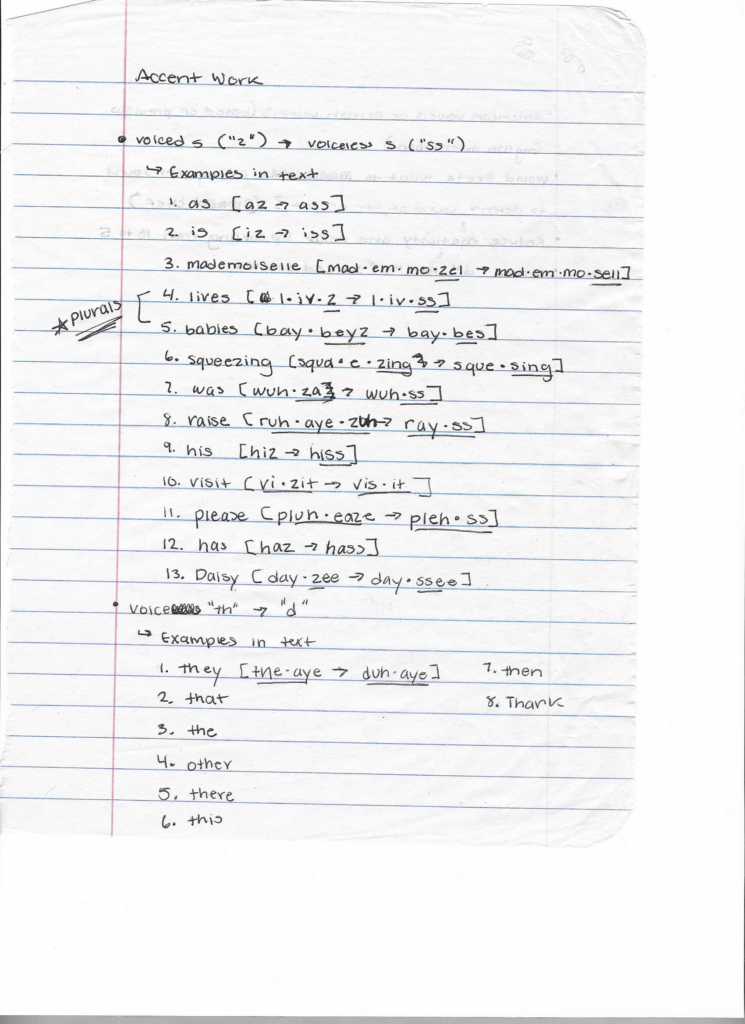
In my accent work preparation, I used mainly the resources Marc provided me with. I started my accent journey by watching native speakers while trying to make similar mouth shapes but producing no sound. For this, I used the video of a Swedish tennis pro being interviewed. I wanted to make sure I had enough practice with the vocal posture before adding sound, specifically the lip curling. Once I had done that for a couple of days I moved on to trying to make the sounds as the native speaker was talking, stopping when I needed to hear a sound again or practice a sound. I continued to use the same video but I also started to use sample 5 of Swedish from the International Dialects of English Archive. I worked this way for quite a while, identifying sounds that were giving me trouble and repeating them. I would then consult the lexical sets outlined in the Swedish accent breakdown by Eric Singer to find the appropriate sound. This brought me to my first accent meeting with Marc where he suggested another video of a woman speaking Swedish casually that would allow me to play with finding the sounds in the language and how they transfer to speaking English. I did in fact use that video to first try to mimic the mouth movements of the speaker and then follow along with the sounds she was making. From this exploration, I found a lot of vowel sounds being made more towards the back of the throat. I continued to use the Swedish 5 example from IDEA and worked on turning “th” sounds as in “this” into “d” sounds as in “dog” and turning the “z” sound, as in “zap” into an “s” sound as in “hiss”. I went through my script and noted any “th” or “z” sounds so that when we started read-throughs and staging I would have the reminder there already. I then moved on to explore Sweden 3 from IDEA because I wanted to see other examples and see if there were any variations between them. I began to read the backs of books out loud in the accent and use it in conversation in my day-to-day life, mainly when talking to my parents in the evening. I would start speaking in the accent and then go back to listen to native speakers to see if I was making similar sounds still. This brought me to my second accent check-in meeting and from this it was suggested that my “r”‘s lose some rhoticity and clarified which “th” words I use a “d” sound for. I also learned a warmup that loosened up the facial muscles to allow sound to flow out more freely and I noticed I was more relaxed by the sides of my mouth when making sounds, so I took this into the rehearsal process and did some variation of it before rehearsals. I continued to speak in the accent by reading things out loud and talking to others as well as checking on my sounds with the IDEA examples after my meeting and during the rehearsal process.
Summer of Sports: Tennis Pro Johanna Larsson on sports & tech – YouTube
Sweden 5 | IDEA: International Dialects of English Archive (dialectsarchive.com)
Sweden 3 | IDEA: International Dialects of English Archive (dialectsarchive.com)
The Swedish language, casually spoken | Johanna speaking Swedish | Wikitongues – YouTube